Finding a good doctor for eye pressure is hard. At Noble Eye Care, we have doctors from AIIMS New Delhi who understand how to save your sight. Our clinic uses new machines to check your eyes carefully. If you need a glaucoma specialist in Gurgaon, our team offers honest advice and treats every patient like family with great care.
Glaucoma Surgery Specialist in Delhi NCR
When eye drops do not work anymore, surgery is the next step. It sounds scary, but it helps a lot. We perform many types of operations to lower the pressure inside your eye. Our surgeons have spent years learning at the best institutes. They know how to handle even the most difficult cases for people living in the capital region.
Helping Younger Patients
Children also get this eye disease sometimes. It is very different from how adults get it. You might need to find a pediatric glaucoma specialist near me to help your child see better. We have special tools for small eyes, and our doctors are very patient with kids.
Finding the Right Clinic
It is important to go to a glaucoma clinic near me that has all the lasers and surgical tools in one place. We do trabeculectomy and also use shunts or valves if the case is tough. Our goal is to make sure your vision stays clear for a long time. Many people say we have the best glaucoma specialist in Delhi because we focus on results and safety above everything else. We explain every step of the surgery so you feel calm.
Advanced Glaucoma Treatment Options at Noble Eye Care
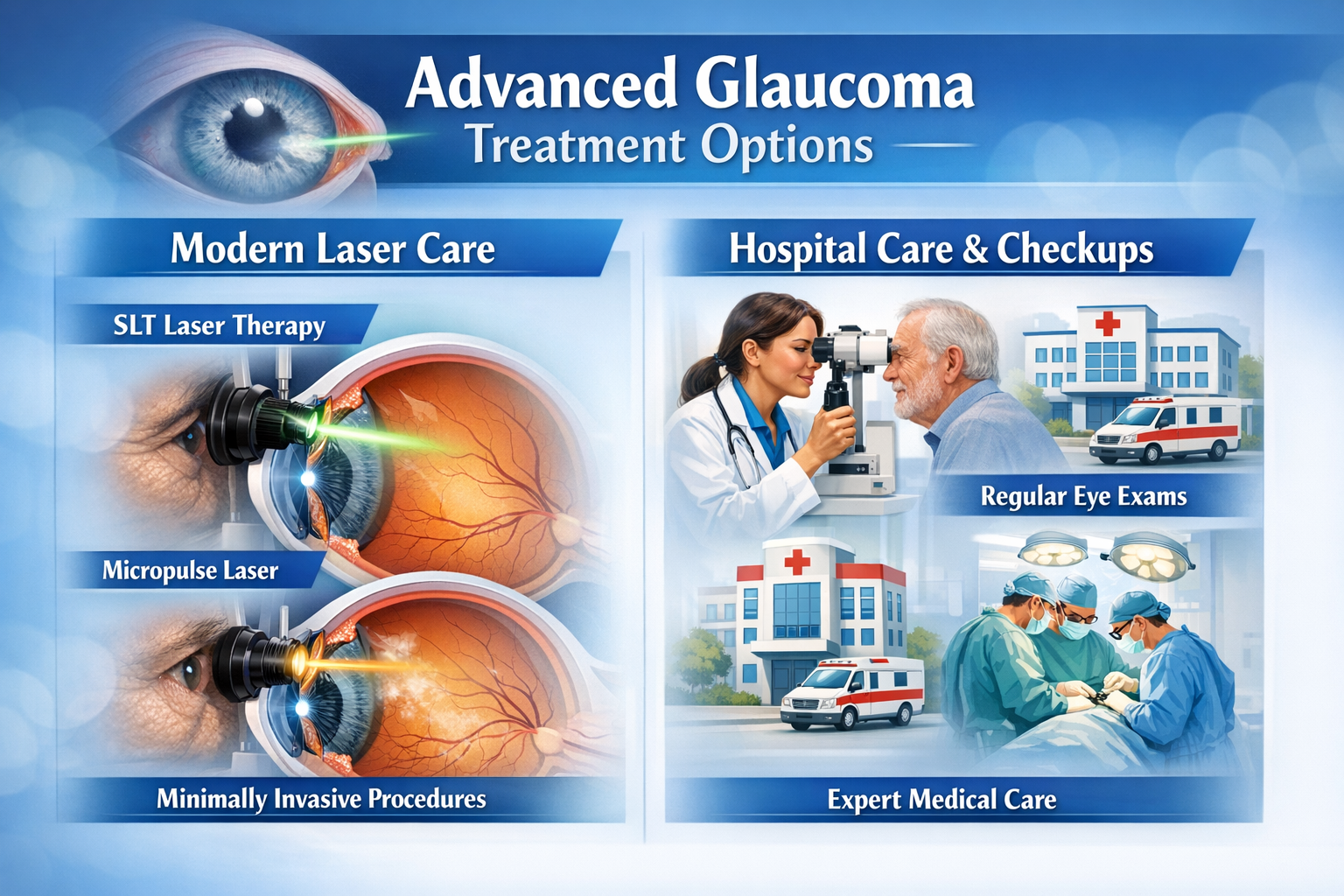
Technology has changed how we look at eye diseases. We do not just give one medicine to everyone. Each person gets a plan that fits their own eyes. We use high-tech scans to see the optic nerve very closely. This helps us catch problems before you even notice your vision is fading.
Modern Laser Care
Sometimes a quick laser is better than daily drops. We offer different laser types that are fast and do not hurt much. If you are looking for a glaucoma specialist doctor in Delhi, you should ask about these options. Lasers can help fluid drain out of the eye more easily.
Hospital Care and Checkups
Visiting a specialized glaucoma eye hospital means you get experts who only focus on this one thing. We keep track of your eye pressure over many months. We also check your side vision using big machines. If you want the best glaucoma specialist near me, we provide the latest care. We use simple methods and advanced medicine to keep your eyes healthy. Our doctors talk to you plainly without using too many big words so you understand your health.
Benefits of Glaucoma Treatment at Noble Eye Care

Choosing where to treat your eyes is a big choice. At our center, we combine old-fashioned ethics with new tools. Our doctors do not rush. They sit with you and talk about your fears. This makes the whole process much easier for elderly patients who worry about going blind.
Expert Medical Team
Our team comes from the top medical college in India. This means they have seen thousands of patients. When you search for a glaucoma specialist near me, you want someone with this kind of deep experience. They know exactly when to change your medicine or when to suggest a different path.
Complete Eye Support
We provide glaucoma eye treatment that covers everything from the first checkup to final surgery. We also help you learn how to put in drops correctly at home. This support is why many call us the best glaucoma specialists near me. We keep our prices fair and our doors open for everyone. Your vision is a gift, and we work hard to protect it every single day. We stay humble and keep learning to serve our patients better in the city.
Best Glaucoma Eye Hospital for Children’s Eye Care Near You
Finding proper care for a child with eye pressure issues is a heavy task for any parent. Pediatric cases are rare and need a very gentle touch. At our center, we focus on the unique needs of young ones who cannot always explain what they feel. A pediatric glaucoma specialist near me is often the first thing parents look for when they notice cloudiness in a baby's eye or constant tearing. These signs are small but mean a lot for future sight.
Our facility works as a dedicated glaucoma eye hospital where kids get tested with tools made for small faces. We know that children feel scared of big machines. Our doctors take time to talk to them and make the room feel safe. We check the eye pressure carefully while the child stays calm.
Special Care for Little Eyes:
- Checking eye fluid levels with kid-friendly devices.
- Watching how the optic nerve grows over time.
- Using medicine that is safe for small bodies.
- Planning surgery only if it is truly the last path.
We aim to keep the vision clear so the child can learn and play without any struggle.
How to Choose the Best Glaucoma Eye Super Specialist
Picking the right doctor for your eyes is a choice that stays with you for years. You want someone who has seen many cases and knows how to handle surprises. A glaucoma specialist should have deep training from top institutes like AIIMS to ensure they know the latest ways to save sight. It is not just about the degree on the wall, but the way they listen to your worries.
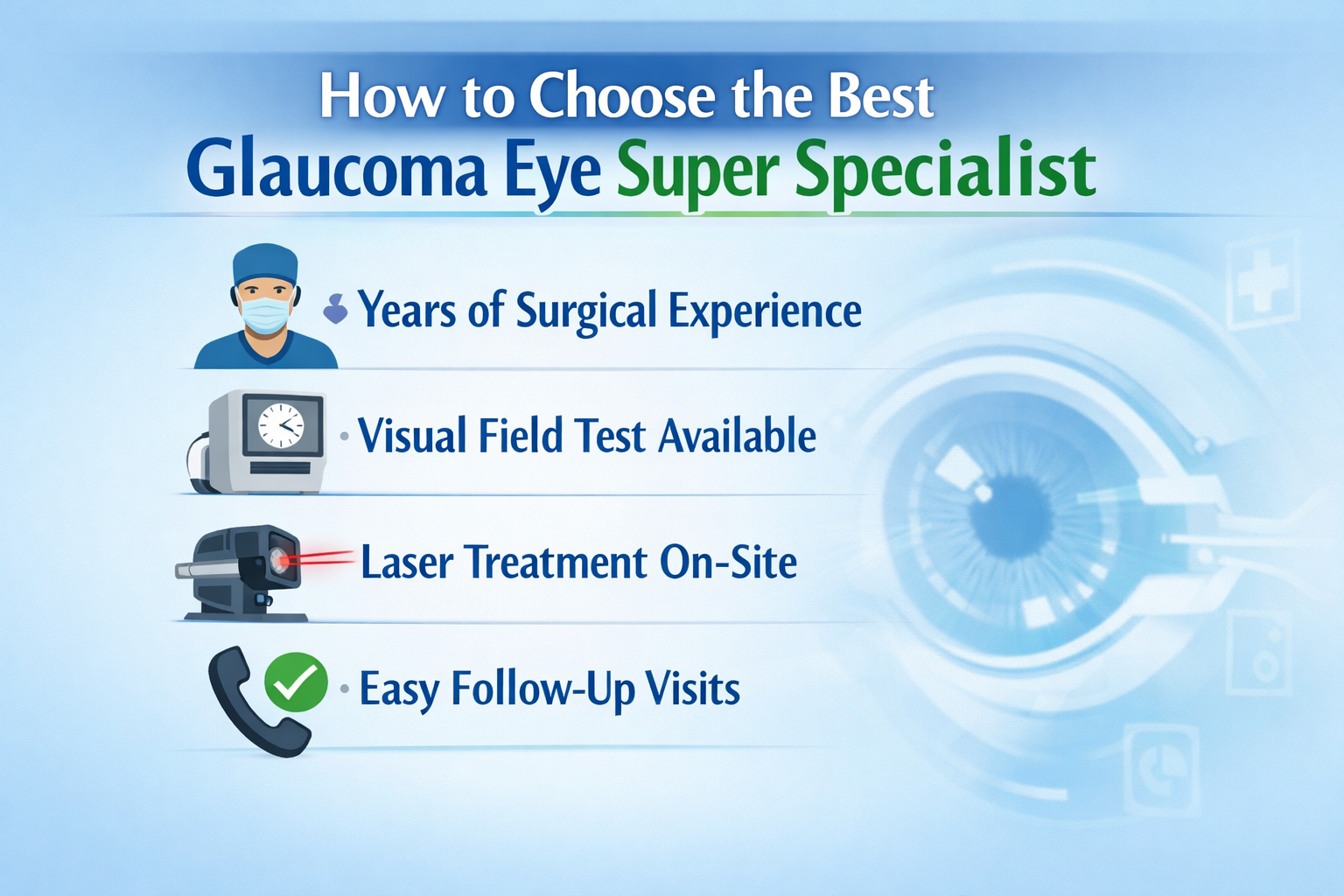
When you look for the best glaucoma specialist near me, check if they have the right tools to map your side vision. A good doctor will explain your test results in plain words. They should not rush you out the door.
What to look for in a doctor:
- Check if they have many years of surgical practice.
- See if the clinic has a visual field test machine.
- Ask if they can provide laser treatments in the same building.
- Make sure they are easy to reach for follow-up visits.
The best glaucoma specialist in Delhi will always put your long-term comfort before anything else. They help you manage the silent nature of this condition with steady care.
Why Choose Noble Eye Care Hospital for Glaucoma Treatment in Gurgaon
Noble Eye Care stands out because we combine high skills with a very honest way of working. Our team comes from AIIMS, New Delhi, bringing a level of knowledge that is hard to find elsewhere. We believe that eye glaucoma treatment should be based on what the patient actually needs, not just on tests. We use the latest machines to catch nerve damage early before it gets worse.
Being a top glaucoma specialist in Gurgaon, our lead surgeons use their vast experience to guide every patient. We handle the most difficult cases with a calm mind. Our clinics in Delhi NCR are built to be clean and modern, but also very welcoming. We do not use confusing medical talk. We tell you the truth about your eye health.
Our Strengths:
- Doctors with training from the best national eye centers.
- Ethics that put the patient's well-being first.
- Latest scanning tech for the optic nerve.
- Multiple locations for easy access.
If you search for a glaucoma clinic near me, you will find that our reputation is built on trust and successful outcomes for thousands of people.
Schedule a Consultation with a Glaucoma Specialist in Gurgaon
Taking the first step toward a checkup can save your sight from fading away. Glaucoma is often called a silent thief because it does not hurt while it takes your vision. Regular visits to a glaucoma specialist near me are the only way to stay ahead of the pressure. At Noble Eye Care, we make it easy to book a time and get a full exam.
Whether you need a routine check or a second opinion, a glaucoma specialist doctor in Delhi at our center will give you a clear plan. We look at your history and family background to see your risk. Waiting too long is never a good idea with eye pressure. Our team is ready to help you keep your world bright and clear.
Steps for your visit:
- Call our desk or visit the website for a slot.
- Bring your old glass prescriptions and reports.
- Meet the doctor for a detailed talk about your eyes.
- Get a personalized plan for drops or laser.
Searching for the best glaucoma specialist in Delhi ends here with our expert team. We look forward to helping you maintain your vision for the years ahead.
FAQ About Glaucoma
Glaucoma is not just one eye disease, but a group of eye conditions resulting in optic nerve damage, which may cause loss of vision. Abnormally high pressure inside your eye (intraocular pressure) usually, but not always, causes this damage.
Glaucoma can damage your vision so gradually you may not notice any loss of vision until the disease is at an advanced stage. The most common type of glaucoma, primary open-angle glaucoma, has no noticeable signs or symptoms except gradual vision loss.
Early diagnosis and treatment can minimize or prevent optic nerve damage and limit glaucoma-related vision loss. It's important to get your eyes examined regularly, and make sure your eye doctor measures your intraocular pressure.
There are mainly 2 types of glaucoma
- 1. Narrow angle glaucoma
- 2. Open angle glaucoma
This type is less severe than the type 2 as one would be aware of it once it hits. People suffering from the type 1 glaucoma would experience pain, redness, and headache which would make you seek the help of an ophthalmologist. It can be treated with laser and usually doesn’t cause in any further complications or problems.
Open angle glaucoma:This type is much more severe than the type 1 as one would not know that the eye is affected until an ophthalmologist diagnosis it and informs about the same. It is more severe as it runs in families and people with a family history must get a routine eye check done after an age of 30 years.
Both open-angle and narrow angle glaucoma can be primary or secondary conditions. They're called primary when the cause is unknown and secondary when the condition can be traced to a known cause, such as eye injury, medications, certain eye conditions, inflammation, tumor, advanced cataract or diabetes.
Primary open-angle glaucoma and Narrow angle glaucoma have completely different symptoms.
Primary open-angle glaucoma signs and symptoms include:
- Heaviness, eye pain.
- Haloes
- Gradual loss of peripheral vision, usually in both eyes
- Tunnel vision in the advanced stages
Narrow angle glaucoma signs and symptoms include:
- Eye pain
- Nausea and vomiting (accompanying the severe eye pain)
- Sudden onset of visual disturbance, often in low light
- Blurred vision
- Halos around lights
- Redness of the eye
In secondary glaucoma, the signs and symptoms can include those of the primary condition as well as typical glaucoma symptoms.
For reasons that doctors don't fully understand, increased pressure within the eye (intraocular pressure) is usually, but not always, associated with the optic nerve damage that characterizes glaucoma. This pressure is due to a buildup of a fluid (aqueous humor) that flows in and out of your eye.
This fluid normally exits your eye through a drainage system at the angle where the iris and the cornea meet. When the drainage system doesn't work properly, the fluid can't filter out of the eye at its normal rate, and pressure builds within your eye.
- Primary open-angle glaucoma
In primary open-angle glaucoma, the drainage angle formed by the cornea and the iris remains open, but the drainage channels (trabecular meshwork) in the angle are partially blocked, causing the fluid to drain out of the eye too slowly. This causes fluid to back up in your eye, and pressure gradually increases within your eye.
Damage to the optic nerve doesn't cause symptoms or pain, and it happens so slowly that you may lose an extensive amount of vision before you're even aware of a problem. The exact cause of primary open-angle glaucoma remains unknown.
- Narrow angle glaucoma
Narrow angle glaucoma, also called closed-angle glaucoma, occurs when the iris bulges forward to narrow or block the drainage angle formed by the cornea and the iris. As a result, fluid can't adequately flow through and exit your eye, and your eye pressure may increase abruptly. Angle-closure glaucoma usually occurs suddenly (acute angle-closure glaucoma), but it can also occur gradually (chronic angle-closure glaucoma).
Some people with an abnormally narrow drainage angle may be at risk of developing angle-closure glaucoma. If you have a narrow drainage angle, sudden dilation of your pupils may trigger acute angle-closure glaucoma.
- Developmental causes
Some infants or children may be diagnosed with glaucoma. Rarely, some children may be born with glaucoma (congenital glaucoma), develop glaucoma in the first few years of life (infantile glaucoma) or develop glaucoma after age 4 or 5 (juvenile glaucoma). Children usually won't have any symptoms. However, they have optic nerve damage, which may be caused by angle blockages or malformations (primary infantile glaucoma), or it could develop as the result of other conditions (secondary glaucoma).
- Pigmentary
In some glaucoma cases, pigment granules from your iris build up in the drainage channels (trabecular meshwork), slowing or blocking fluid exiting your eye. Physical activities, such as jogging, sometimes stir up the pigment granules, depositing them on the trabecular meshwork and causing intermittent pressure elevations
Because chronic forms of glaucoma can destroy vision before any signs or symptoms are apparent, be aware of these factors:
Elevated internal eye pressure (intraocular pressure):
If your internal eye pressure (intraocular pressure) is higher than normal, you're at increased risk of developing glaucoma, though not everyone with elevated intraocular pressure develops the disease.
Age:You're at a higher risk of glaucoma if you're older. You may be at higher risk of angle-closure glaucoma if you're older than age 40. For certain groups the risk of developing glaucoma is much higher and occurs at a younger age than that of other groups. If you're 30 years and above you must have regular eye test done.
Family history of glaucoma:If you have a family history of glaucoma, you have a greater risk of developing it. Glaucoma may have a genetic link, meaning there's a defect in one or more genes that may cause certain individuals to be more susceptible to the disease. A form of juvenile open-angle glaucoma has been clearly linked to genetic abnormalities.
Medical conditions:Several conditions may increase your risk of developing glaucoma, including diabetes, heart diseases, high blood pressure and hypothyroidism.
Other eye conditions:Severe eye injuries can cause increased eye pressure. Other eye conditions that could cause increased risk of glaucoma include eye tumors, retinal detachment, eye inflammation and lens dislocation. Certain types of eye surgery also may trigger glaucoma. Also, being nearsighted or farsighted may increase your risk of developing glaucoma.
Long-term corticosteroid use:Using corticosteroid medications, especially eye-drops for a long period of time may increase your risk of developing secondary glaucoma.
Your doctor will review your medical history and conduct a comprehensive eye examination. Your doctor may perform several tests to diagnose glaucoma, including:
Measuring intraocular pressure by the Applanation Tonometer or the non contact Tonometer.
Tonometry is a simple, painless procedure that measures your internal eye pressure (intraocular pressure), after numbing your eyes with drops. It's usually the initial screening test for glaucoma.
Test for optic nerve damage.To check for damage in your optic nerve, your eye doctor uses instruments to look directly through the pupil to the back of your eye. This can reveal slight changes that may indicate the beginnings of glaucoma.
Visual field test using the Field analyzer:To check whether your visual field has been affected by glaucoma, your doctor uses a special test to evaluate your side (peripheral) vision.
Visual acuity:Your doctor will test your ability to see from a distance.
Measuring cornea thickness (pachymetry):Your eyes are numbed for this test, which determines the thickness of each cornea, an important factor in diagnosing glaucoma. If you have thick corneas, your eye-pressure reading may read higher than normal even though you may not have glaucoma. Similarly, people with thin corneas can have normal pressure readings and still have glaucoma.
Other tests:To distinguish between open-angle glaucoma and narrow angle glaucoma, your eye doctor may use a technique called gonioscopy in which a special lens is placed on your eye to inspect the drainage angle. Other tests, such as imaging tests like optical coherence tomography, HRT have been developed and may sometimes be used.
The goal of glaucoma treatment is to lower pressure in your eye (intraocular pressure). To treat your condition, doctors may lower your eye pressure, improve drainage of fluid in your eye or lower the amount of fluid produced in your eye.
-
Eye-drops
- Laser surgery:
You may have an outpatient procedure called laser trabeculoplasty to treat open-angle glaucoma. After giving you a numbing eye-drop, your doctor uses a high-energy laser beam to open clogged drainage canals and help fluid drain more easily from your eye. Your doctor will need to check your eye pressure several times in the following weeks. It may take a few weeks before the full effect of the surgery becomes apparent. Laser surgery for glaucoma initially lowers pressure in your eye (intraocular pressure). Over time, however, the intraocular pressure may begin to increase.
- Filtering surgery:
If eye-drops and laser surgery aren't effective in controlling your eye pressure, you may need a surgical procedure called a trabeculectomy. This procedure is performed in a hospital or an outpatient surgery center. You'll receive a medication to help you relax and usually an injection of anesthetic to numb your eye. Using small instruments under an operating microscope, your surgeon creates an opening in the sclera the white of your eye and removes a small piece of eye tissue at the base of your cornea through which fluid drains from your eye (the trabecular meshwork). The fluid in your eye can now freely leave the eye through this opening. As a result, your eye pressure will be lowered.
Your surgery will be performed on one eye. If necessary, several weeks later you might have surgery on the other eye. You may need additional procedures or treatments, as the opening sometimes heals over or other changes occur in your optic nerve.
Your doctor will check your eye during several follow-up visits, and you'll need to use antibiotic and anti-inflammatory eye-drops to fight infection and scarring of the newly created drainage opening.
- Drainage implants:
Some people with advanced glaucoma, secondary glaucoma or children with glaucoma may be eligible for drainage implants. Drainage implant surgery takes place in a hospital or an outpatient clinic. In this procedure, your eye surgeon inserts a small tube in your eye to facilitate draining fluid (aqueous humor) from your eye to reduce the pressure.
Glaucoma treatment often starts with medicated eye-drops. Be sure to use the drops exactly as prescribed. Otherwise, your optic nerve damage could get even worse. If your doctor prescribes more than one type of eye-drop, make sure to ask how long to wait between applications and to take the drops for as long as your doctor has prescribed them.
Oral medicationsIf eye-drops alone don't bring your eye pressure down to the desired level, your doctor may also prescribe an oral medication, usually in the form of a carbonic anhydrase inhibitor, to reduce your eye pressure. This medication may cause side effects including frequent urination, a tingling sensation in the fingers and toes, depression, stomach upset, and kidney stones.
SurgeryYou may need surgery to treat glaucoma if you can't tolerate medications or if they're ineffective. Sometimes a single surgical procedure may not effectively lower your eye pressure. You may need to continue using eye-drops, or you may need another procedure. Surgeries that may be performed to treat glaucoma include:
Another procedure performed within the eye removes a targeted strip of the trabecular meshwork with a small tool. Your surgeon inserts the tool into the eye's drainage canal through a small incision at the edge of the cornea and removes the small section of trabecular meshwork. This helps fluid drain more easily from your eye.
In trabeculectomy and drainage implants, the fluid is directed to a blister (bleb) on the outer layer of your eyeball where it can be absorbed.
Glaucoma is a preventable cause for blindness. The following will reduce the chance of developing glaucoma or damage related to it.
- Get regular eye check up:
Regular comprehensive eye exams can help detect glaucoma in its early stages before irreversible damage occurs. As a general rule, have comprehensive eye exams every three to five years after age 40 and every year after age 60. You may need more frequent screening if you have glaucoma risk factors.
- Treat elevated eye pressure:
Glaucoma eye-drops can significantly reduce the risk that elevated eye pressure will progress to glaucoma. To be effective, these drops must be taken regularly even if you have no symptoms.
- Eat a healthy diet:
While eating a healthy diet won't prevent glaucoma, it can improve your physical and mental health. It can also help you maintain a healthy weight and control your blood pressure.
- Wear eye protection:
Serious eye injuries can lead to glaucoma. Keep your eyes protected when you use power tools or play high-speed racket sports on enclosed courts. Also wear hats and sunglasses if you spend time outside.
- - Highly experienced ophthalmologists who are specifically trained in glaucoma from AIIMS, New Delhi
- - Latest State-of-the art equipment for diagnosing and managing glaucoma
- - Comprehensive evaluation of ocular and systemic conditions
- - Fully equipped operating theatre for glaucoma surgery
